
 Analysis by Gamescozy
I like casual puzzle games that make me pause for a moment rather than ask for a long, uninterrupted session. Bus Fever Party is built around that kind of small challenge: traffic is jammed, buses need to get moving, and the puzzle is to work out how to clear a path. Its premise is easy to grasp, but the appeal depends on whether you enjoy thinking through a crowded layout instead of simply tapping through an action game.
What free access means here
Bus Fever Party is a free casual game from Lumi Games, so you can try its core experience without paying an upfront price. The game is rated for Everyone, and its current version is 1.2.9. In-app purchases are offered, with individual items priced from $1.99 to $99.99. That range is worth noticing: free entry is clear, but the upper end is substantial, so I would check the purchase details carefully before spending.
The game has an average rating of 4.1 from around 55,000 ratings, with roughly 1,100 written reviews and over 10 million installs. Those figures suggest it has attracted a sizable audience, but they are not a guarantee that its puzzle style will suit you. It was released on April 23, 2025, and requires Android 8.0 or later.
For me, the practical buying question is not whether the game costs money to download—it does not—but whether the free play feels satisfying enough without purchases. I would begin with the free experience and treat optional spending as a separate decision. A listed purchase range does not tell me which items are necessary or what they add, so I would not assume that paying is required to enjoy the basic idea.
A small puzzle built around traffic flow
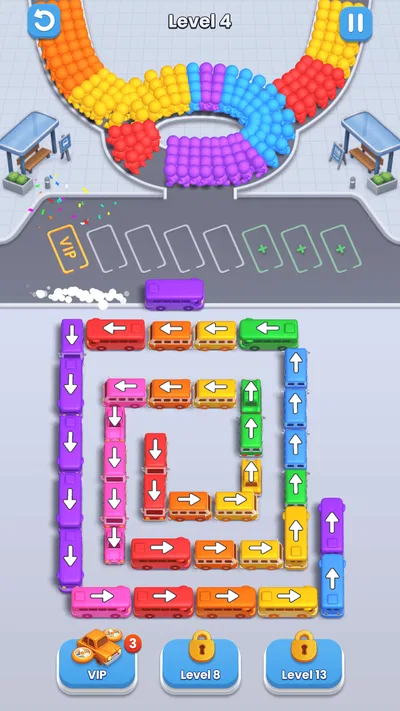
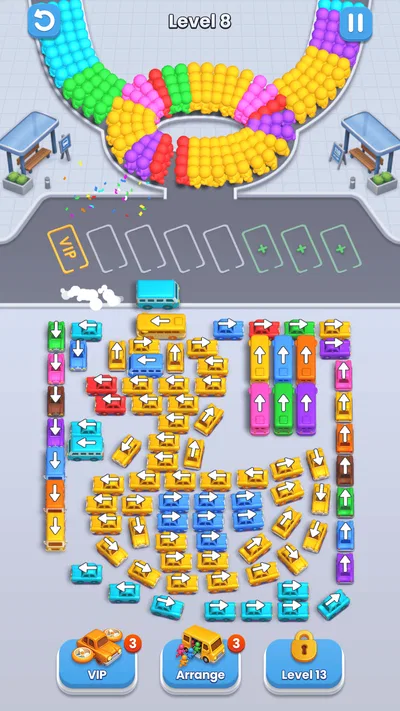
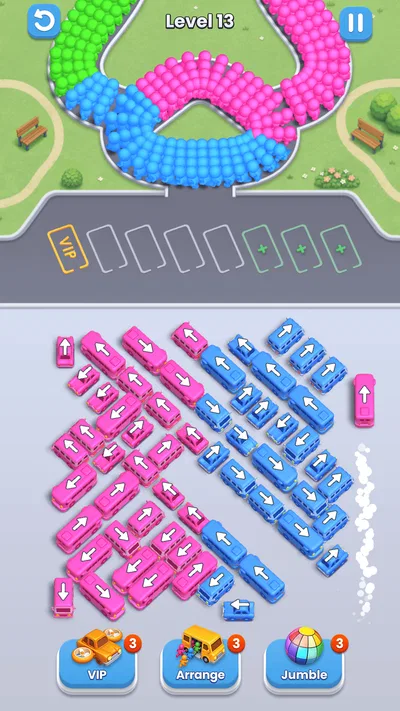
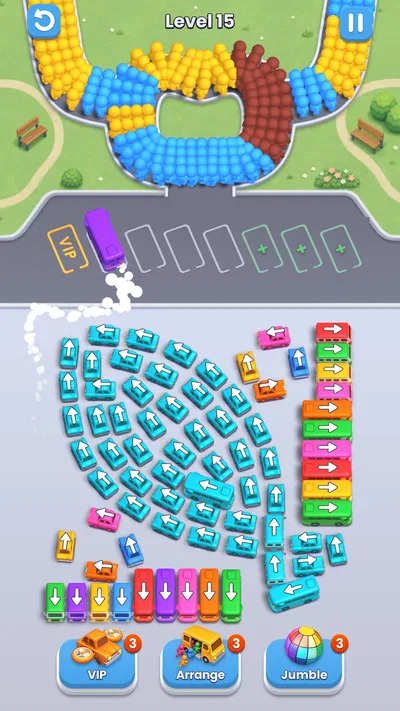
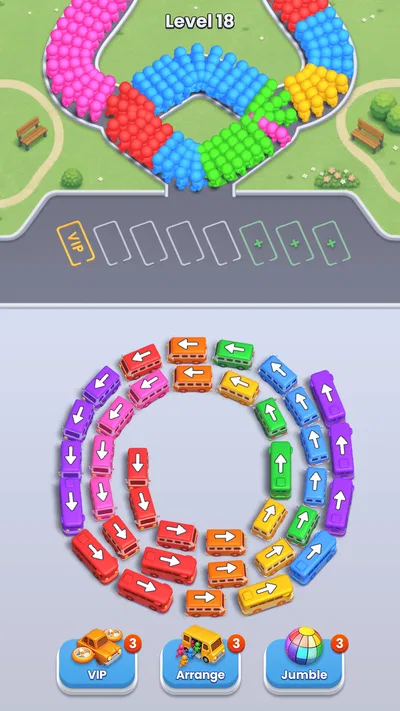
The central task is to untangle a bus and parking jam. That makes the game more spatial than a standard match-and-clear puzzle: progress comes from reading where vehicles are blocked and considering which move could open room for others. A move that looks helpful at first may simply shift the blockage, so it pays to inspect the whole arrangement before acting.
That planning is the best reason to try it. I find this sort of puzzle satisfying when a board looks stuck and a sequence of modest moves gradually reveals a route out. It gives a short session a clear objective, without requiring the kind of reflexes or commitment I expect from a racing game. The short description, “Bus Fever Party!”, points to a light tone, while the actual hook is the traffic-clearance problem underneath it.
A useful habit is to identify the bus you ultimately need to free, then trace what is directly preventing it from moving. From there, I would look for a move that creates space rather than making the most obvious available move. This approach is not a guaranteed solution to every layout; it is a way to avoid wasting turns on changes that leave the main obstruction untouched.
Where the value comes from
The value here is the puzzle loop, not a promise of elaborate systems. If I have a few spare minutes while waiting for an appointment or taking a break, a traffic puzzle gives me a concrete problem to focus on and a natural stopping point once I have cleared it. It is also easy to explain to someone else: look at the jam, work out what must move, and make room for the bus.
Compared with the usual casual alternatives, this is a better fit for someone who likes spatial reasoning than for someone who wants rapid matching, a story to follow, or continuous action. In a match-style game, I might react to changing pieces; here, the satisfying part is anticipating how one vehicle’s movement affects the available space. That difference gives the game a distinct niche, though it also narrows its audience.
One practical way to judge whether it is worth keeping is to notice how you feel after a few puzzles. If you enjoy reconsidering a layout and spotting a more efficient sequence, the free entry gives you a low-risk way to test that interest. If you find yourself tapping randomly or feeling that the traffic arrangement is more irritating than clever, paying for extras is unlikely to fix the mismatch in taste.
The tradeoffs I would keep in mind
The same focus that makes the premise clear can become limiting. A bus jam is a specific puzzle theme, and the appeal depends on the layouts continuing to feel engaging rather than repetitive. I would not choose it as my main game if I wanted a broad mix of activities, a deep narrative, or the social competition often found in other casual titles.
There is also a difference between being free to start and knowing the full value of every purchase. Since individual in-app items range from $1.99 to $99.99, I would avoid treating the highest price as a sensible default or assuming that an item is essential. Before buying anything, I would read the item description in the app store and consider whether it addresses a real frustration I have encountered. If I am enjoying the puzzles without spending, there is no reason to pay just because an option appears.
Another tradeoff is the amount of deliberate thought the game asks for. A traffic-clearing puzzle is not ideal when I want to switch off completely or when interruptions make it hard to remember a sequence of moves. If I need something soothing and nearly automatic, a simple idle or coloring game may fit better. If I want a puzzle but prefer words or numbers to spatial layouts, a word or logic game is a more natural alternative.
I would also separate the game’s easy-to-understand premise from the difficulty of any particular board. Knowing that the aim is to free a bus does not automatically make the solution obvious. When I get stuck, I would stop moving vehicles for a moment, look for the tightest bottleneck, and work backward from the route that needs to be open. That pause can make a puzzle feel like a reasoning challenge rather than a sequence of guesses.
Who is likely to get the most out of it?
I would recommend giving it a try if you like compact spatial puzzles, enjoy planning a few moves ahead, and want a casual game that does not depend on fast reactions. It may work particularly well as a brief break: the goal is visible, and the traffic problem gives your attention something specific to do. The Everyone age rating also makes it broadly accessible, although individual preferences and comfort with in-app purchases still matter.
It is less suited to players who want a large variety of modes, a strong sense of progression, or a game they can play without thinking. I would also suggest skipping it if traffic-themed puzzles do not appeal to you; the core idea is the reason to install it, not a small feature that can be ignored. If you usually prefer action, competitive play, or a story-led adventure, another game in those styles is more likely to hold your interest.
For a shared everyday moment, I can imagine handing the phone to a friend and asking them to find the move that opens the jam. That works because the challenge is legible at a glance, rather than requiring a long explanation. It is a good fit for casual, informal play, but I would not mistake that simple premise for a substitute for a deeper strategy game.
My verdict on whether to try it
Bus Fever Party earns its place as a free-to-start casual puzzle for people who enjoy clearing blocked routes through careful moves. I like that its central challenge is immediately understandable while still leaving room to think through the order of actions. Its 4.1 average rating and large install base offer some context about its reach, but my recommendation rests more on whether you enjoy this particular kind of spatial problem.
I would download it if I wanted a light traffic puzzle and was comfortable judging the free experience on its own. I would skip it if I needed variety, a passive game, or a reason to spend money before knowing what the purchases provide. In short, it offers a straightforward way to test whether bus-and-traffic puzzles are your kind of casual play; start free, take your time with the layouts, and only consider an optional purchase if you can name the value you expect from it.